Patients are not ordinary customers. They may be anxious, unwell or caring for someone who is, and the messages they get from a clinic, hospital or health app land in the middle of their lives. Good communication reduces missed appointments, helps people follow care plans and builds trust. Poor communication, such as a reminder that reveals a condition on a lock screen, can cause real harm. This guide explains how healthcare providers and health-tech teams can communicate with patients responsibly: which messages are worth sending, how to protect privacy, how to handle consent, which channels fit, how to keep marketing and care separate and what to measure.
An important note. This article is general marketing and communication guidance. It is not medical or legal advice. Rules on patient privacy and health data differ by country and change, so confirm what applies to you with your legal and compliance advisors and the official sources.
What patient communication covers
Patient communication spans administrative messages (appointments, reminders, directions, billing), care-support messages (preparation instructions, medication adherence prompts approved by clinicians, follow-up check-ins), educational content and, separately, marketing (health camps, new services, wellness packages). Each kind has a different purpose, different expectations and different rules. Our healthcare solutions page shows how these fit together on one platform, and the general principles in customer engagement apply with extra care.
Messages patients value
| Moment | Message | Why it helps |
|---|---|---|
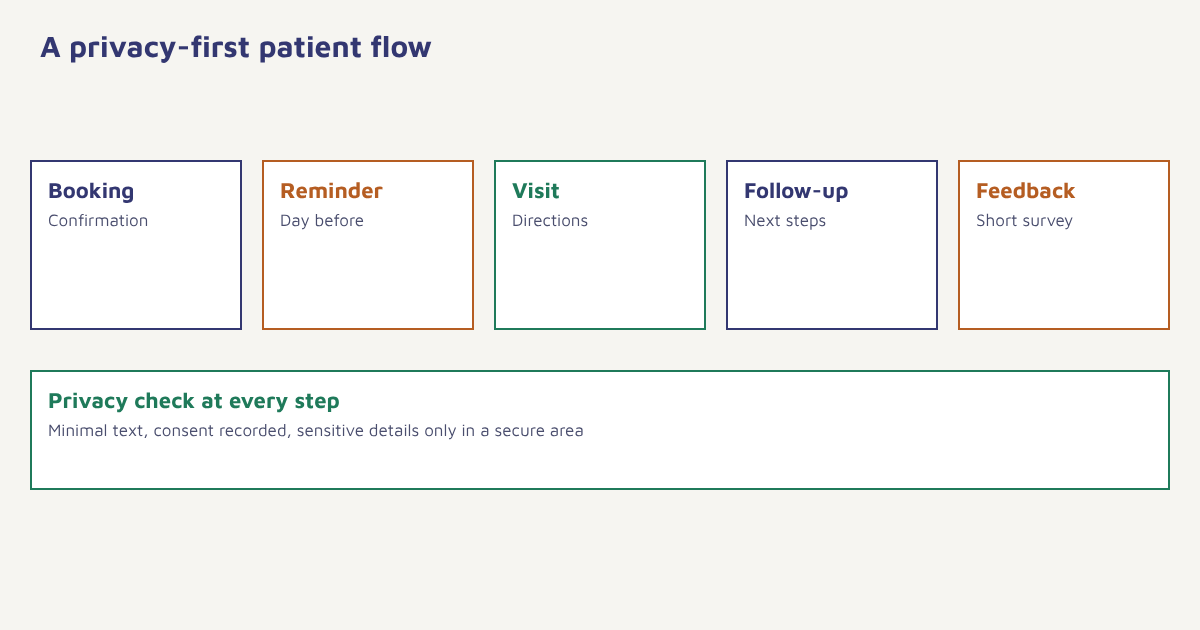
| Booking | Confirmation with date, time, place and how to reschedule | Removes doubt |
| Day before | Reminder with preparation instructions | Fewer missed visits and better preparation |
| Day of | Directions, parking, what to bring | Smoother arrival |
| After visit | Thank-you, summary of next steps from the clinician | Clarity and follow-through |
| Follow-up | A check-in or reminder for a repeat visit | Continuity of care |
| Lab or report ready | Notification that a report is available, with a secure link | Prompt access without exposing results |
| Feedback | Short survey on the experience | Improves service. See NPS, CSAT and CES |
Privacy comes first
A rule of thumb. Assume that anyone might see a message on a phone screen. Say what is necessary and nothing more, and keep diagnoses, test results and treatment details out of notification text.
- Keep content minimal. "Your appointment is on Tuesday at 4 pm" is better than naming the department or the reason for a visit when that could reveal a condition.
- Link to a secure area. Share results and records inside a protected portal or app, not in plain messages.
- Use a verified channel. Confirm phone numbers and email addresses at registration and let patients choose how they are contacted.
- Limit access. Only staff who need to send or view data should be able to.
- Keep records. Log consent and communications.
The field of health data protection is shaped by laws and standards that differ widely. Examples that readers sometimes ask about include the US HIPAA and the EU GDPR, and India’s Digital Personal Data Protection Act applies to digital personal data generally. Do not assume that a single rule covers your situation. Read our DPDP Act guide for marketers for a general view, and ask your advisors how health information and sector rules apply to your messages. For general background, see the articles on medical privacy and health communication.
Consent and preferences
Record how and when each patient agreed to be contacted, for what purpose and on which channel. Appointment reminders usually serve the patient’s own care, but promotional messages, such as an offer on a health package, need clear and separate permission. Offer an easy way to change preferences, and respect them across every channel. Our guide to consent management explains how to store and apply permissions, and SMS opt-in and opt-out covers the practical side for text messages. In Flowfox, consent is stored per channel on the contact profile, so a patient who opts out of promotions can still receive appointment reminders if they agreed to those.
Choosing channels
| Channel | Good for | Cautions |
|---|---|---|
| SMS | Short reminders, OTPs, reschedule links | Keep text minimal. Template and sender rules apply |
| Two-way scheduling, reminders, document help | Consent, approved templates, no clinical detail in text | |
| Preparation guides, bills, newsletters | Do not include sensitive details in the body | |
| Push and in-app | Portal updates, reminders for app users | Notification text visible on lock screens |
| Voice or human call | Complex or sensitive matters, elderly patients | Higher cost, use where it counts |
Not every patient is comfortable with apps, so offer a choice and a human fallback. Elderly patients and those with limited literacy may prefer a phone call or a message in their own language. Our channel comparison and the pages for SMS and WhatsApp give more detail.
Keep care and marketing apart
A patient who receives a reminder for a follow-up visit should not, in the same message, see an advertisement for an unrelated service. Use separate templates, separate consent and clear labelling. Be especially careful with claims: health advertising is regulated in many countries, and statements about outcomes, cures or comparisons may be restricted. Avoid fear-based wording, never imply a diagnosis and let clinicians review educational content. Ask your compliance advisor to review any promotional copy before you send it.
A step-by-step plan
- List the messages in the patient journey. From booking to follow-up and feedback.
- Classify each as care-related or promotional. Different consent and rules.
- Write minimal, clear templates. No sensitive details, one action per message.
- Collect and store consent. By channel and purpose, with easy changes.
- Set timing. Reminders at sensible times, not late at night.
- Add a human route. A phone number or reply path for questions.
- Measure and improve. Track no-shows, confirmations and complaints.
A worked example (invented)
Picture a multi-doctor clinic where about one in six booked appointments is missed. The clinic sets up a journey: a confirmation immediately after booking, a reminder the evening before with a one-tap reschedule link, and a short message on the morning of the visit with the address. Messages never name the doctor’s speciality or the reason for the visit. Patients who tap reschedule are offered the next three slots, and the freed slots go to a waiting list. After a few months the clinic compares no-show rates against the earlier period and against a small control group that kept the old process. The clinic, numbers and results are invented to illustrate the approach, and your own results will differ.
What to measure
| Metric | Meaning |
|---|---|
| No-show rate | Share of booked appointments missed |
| Reminder confirmation rate | How many patients confirm or reschedule |
| Rebooking rate | Patients who book follow-ups |
| Opt-out and complaint rate | Whether frequency and content are right |
| Satisfaction score | Overall patient experience |
Compare groups fairly and avoid drawing conclusions from small numbers; the habits in A/B test sample size help. In Flowfox, analytics reports on these by channel and segment, and a journey automates the flow. See transactional emails for related ideas.
Tone and accessibility
Write the way a considerate receptionist would speak: warm, short and specific. Avoid medical jargon and abbreviations that patients may not know, and offer messages in the languages your patients use. Think about accessibility too. Large, clear text, simple links and the option of a voice call help older patients and those with visual impairments. Be careful with humour and emojis, which can feel out of place when someone is worried. Finally, give people a way to say "this message was not meant for me", because phone numbers change hands and a wrong-person alert should be fixed quickly and quietly.
Common mistakes
- Revealing a condition in a message. Lock screens are public.
- Mixing promotions into care messages. It breaks trust and may break rules.
- No way to reply or reschedule. Reminders should reduce effort, not add it.
- Ignoring language and literacy. Reach patients the way they are comfortable.
- Skipping legal review. Health communication is regulated.
The best patient message tells people exactly what they need and nothing that someone else should not see.
Reduce missed appointments with careful reminders. Automate confirmations and reminders across SMS, WhatsApp and email with consent built in.
Read next: transactional emails, the customer feedback loop and the blog.
Frequently asked questions
What is patient communication?
Patient communication covers the administrative, care-support, educational and promotional messages that providers and health apps send to patients, such as appointment reminders and follow-ups.
What should appointment reminders include?
Date, time, place, how to reschedule and any preparation instructions, with no diagnosis, test results or sensitive reasons for the visit.
Can I send promotions to patients?
Only with clear and separate permission, kept apart from care messages, and with copy that meets advertising rules for health services. Ask your compliance advisor to review it.
Is WhatsApp suitable for patient messages?
It can be used for scheduling and reminders with consent and approved templates, but keep clinical detail out of the message text and link to a secure area for sensitive information.
How do I protect patient privacy in notifications?
Keep content minimal, avoid naming conditions or results, send details through a secure portal and let patients choose their channels.
How do I reduce missed appointments?
Send a confirmation, a reminder with an easy reschedule option and a same-day message, and compare no-show rates against a control group.
Which laws apply to patient messaging?
It depends on your country and activities. Examples include health privacy laws and general data protection laws, so confirm with legal advisors and official sources.